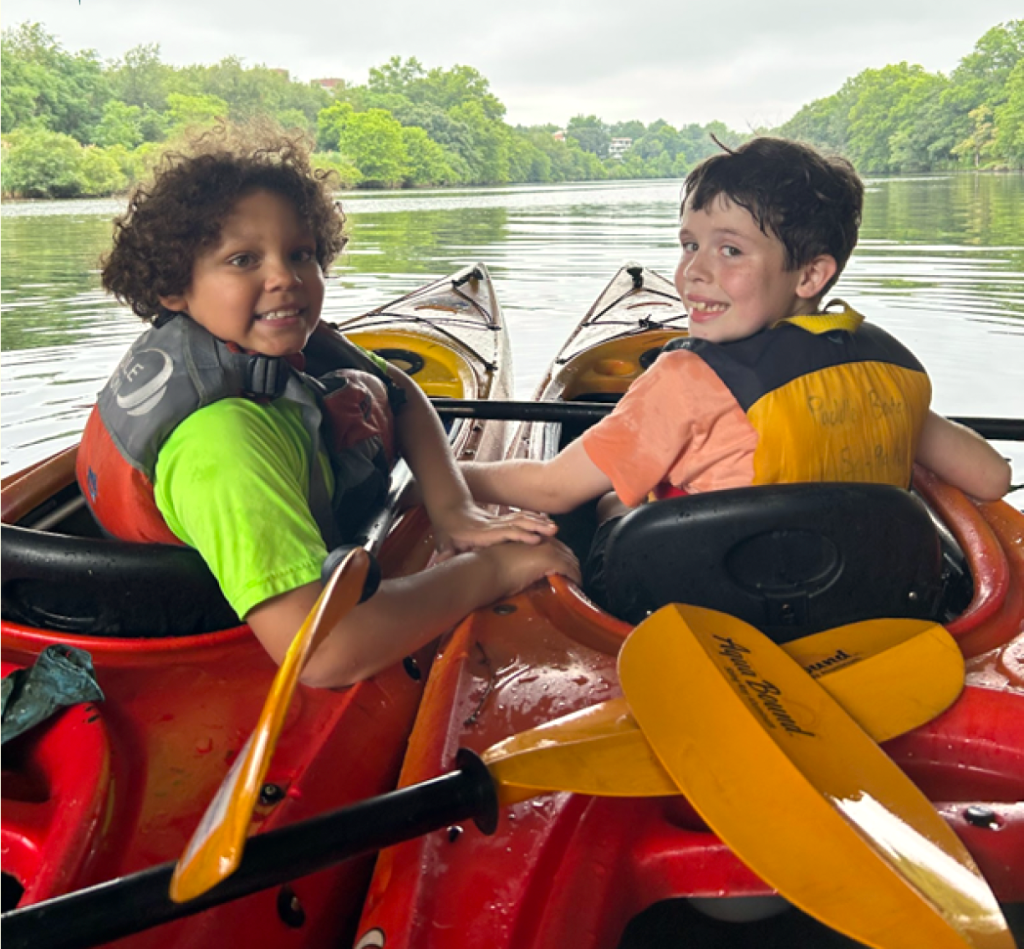
When JOYweavers’ summer day camp opened for its third season last July, Executive Director and Founder Mia Klinger and her team wanted to take a deeper dive into creating a truly inclusive community. They aimed to be quicker in responding to signs that children were feeling agitated while also focusing on children whose struggles are less obvious. “Sometimes kids impacted by trauma are unbelievably compliant,” Mia explains. “Teachers love them because they’re doing everything they’re expected to. But these youngsters are holding great stress within their bodies, and we want as much concern and attention on them as their peers.”
JOYweavers also needed to find a more comfortable way for children and adults to make repairs after a hard moment. Like the “shout-outs” at all-camp breakfast that allow campers to voice their appreciation, “We introduced a new piece called ‘My Bad,’ Mia says. “and it became contagious, with campers saying things like ‘Hey, I’m sorry I was so slow to come off the playground and everybody had to wait.’ Their ‘My Bad’ apologies were heartfelt and spontaneous, as opposed to something a parent or teacher might make them do.”
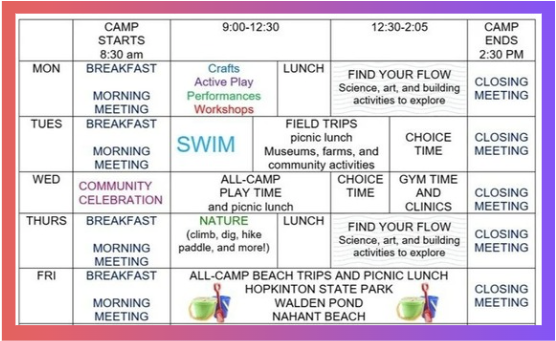
Along with traditional camp programming like swimming, crafts, field trips, and playground/gym time, twice a week JOYweavers offers STEAM programming called “Find Your Flow”(FYF), a camp favorite. During FYF, campers explore themed hands-on learning activities at their own pace and according to their interest.
“The passion and the power of what the camp setting offers to kids has always been very important and powerful in my world,” she continues. Mia herself is a lifelong “camp kid” who attended her first day camp at age four.
When Mia founded JOYweavers in 2022, she was determined to make it strength-based. “The campers are not broken, and we’re not fixing them. They’re just little people who come to play and have some shaky skills around how to be successful in groups.” She also wanted campers’ families to be an integral part of the experience. “Within the first couple days, we try to reach out to all families and then keep connecting with them so that when they see our phone number, they don’t think their child’s in trouble.” As campers’ families get to know JOYweavers, they feel more comfortable sharing their concerns and reaching out for help.
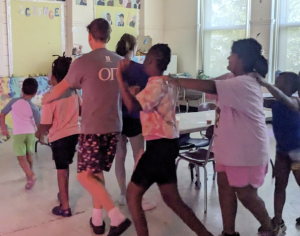
This past summer, JOYweavers had 34 campers, ages 5 to 13, with histories of trauma or other invisible disabilities, such as autism, anxiety or learning difficulties. Within the safety of camp, with trusted counselors around them, campers learned self-regulation and problem-solving skills. They were supported by a staff of counselors and teens (counselors-in-training) with a 2:1 camper-to-counselor ratio. Fully half of the staff knew camp from both an adult and child perspective. They had been campers at JOYweavers or in another program Mia and her team had directed in the past.
Eleven-year-old Lena is one of many campers who has shown remarkable growth. “When we first met Lena, she was really disengaged and spent a lot of the school day rolling on the floor, climbing under desks, or just sitting in various administrators’ offices,” Mia recalls. “Camp was different. Lena got intensive one-to-one adult support that first summer, and when I walked into the school building in late spring to drop off her application to return, she saw me in the hallway, yelled ‘camp!’ and started dancing.”
In 2025, Lena had an extremely difficult year. “The lives of JOYweavers campers and families can be very complicated,” Mia says. “We thought that Lena might come back to camp overwhelmed and dysregulated. And there were a few days of her needing near constant adult attention. But the next thing I knew, she was playing basketball and riding on scooters with friends, which I had never seen her do. When she was sad, other campers came and sat with her, unprompted, bringing beads and games to make her feel better. Her trajectory has been unbelievably lovely to witness.”
Designing programs and supporting children with social-emotional needs is second nature to Mia after nearly 40 years working with youth. Managing a nonprofit, however is something she’s had to learn. “I have been very honest about the role,” she comments. “I was a really good Special Ed teacher and reading specialist, but I’d never been an executive director and had only a little knowledge of grant writing, fiscal sponsorship and other administrative concerns.”
This coming year, Mia is looking forward to learning more as part of The Lenny Zakim Fund 2026 Transformational Leadership Cohort (TLC). “I feel like JOYweavers is at this moment of great potential,” she says, “and I don’t think that would have existed without The Lenny Zakim Fund.”
—————————————————————-
Current needs at JOYweavers include finding additional sources of funding and donations. They are also interested in building relationships with partner organizations in and around Cambridge who would like to collaborate on school-year programming. If you’d like to connect, please contact Mia Klinger at mia@joyweavers.org.